In this article, you'll learn:
What acupuncture is and what to expect during a treatment
How Traditional Chinese Medicine understands health, Qi, and the body's channels
How acupuncture stimulates the nervous system and influences the body's natural healing responses
What modern scientific research tells us about how acupuncture works
Why acupuncture can be used to support such a wide range of health concerns
What Is Acupuncture and How Does It Work?
One of the questions I hear most often from new patients is, "How does acupuncture actually work?"
It's a great question—and honestly, not always an easy one to answer in just a few minutes during an appointment.
Acupuncture is part of a medical system called Traditional Chinese Medicine (TCM) that has been practiced for more than 2,500 years. During my four years of graduate training, I spent countless hours learning both the traditional theories behind acupuncture and the growing body of modern scientific research that helps explain its effects. Even then, it's difficult to summarize thousands of years of knowledge in a brief conversation.
Whether you're simply curious or considering your first treatment, I hope this article helps explain both the traditional and modern perspectives of how acupuncture works.
What Is Acupuncture?
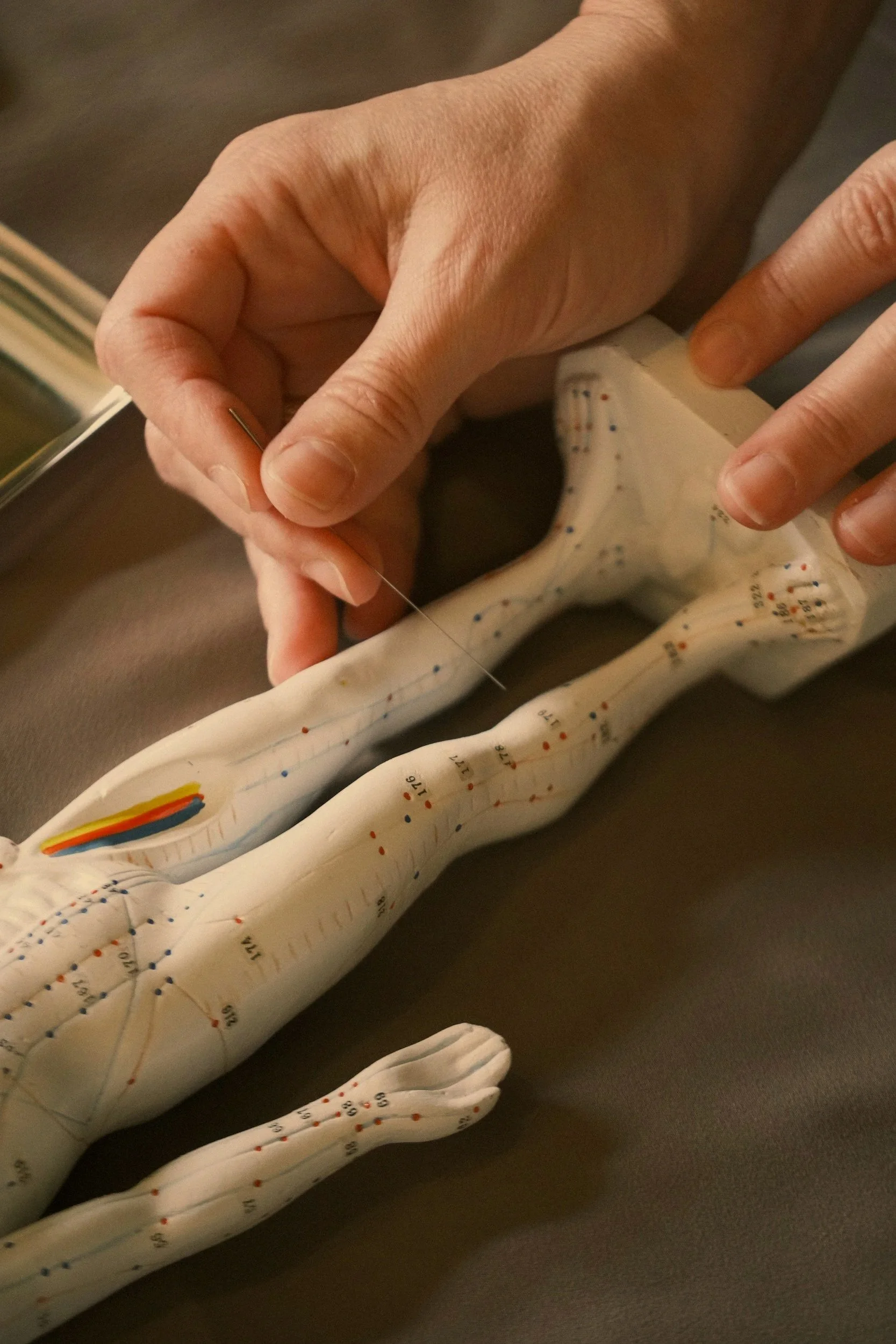
Acupuncture is one of the primary therapies within Traditional Chinese Medicine. During a treatment, very fine, sterile needles are inserted into carefully selected points on the body to encourage healing and restore balance.
Although acupuncture is the treatment most people think of first, it's only one part of Traditional Chinese Medicine. Depending on your needs, treatment may also include therapies such as cupping, gua sha, acupressure (Tui Na), lifestyle recommendations, or Chinese herbal medicine. Each of these therapies works together to support the body's natural healing processes.
If you're nervous about needles, you're certainly not alone. Fortunately, there are many techniques that don't involve needles at all, and treatments can often be adapted to your comfort level.
What Does an Acupuncture Treatment Feel Like?
One of the biggest surprises for first-time patients is just how small acupuncture needles are. They're much thinner than the needles used for injections or blood draws.
As a needle is inserted, you may feel a brief pinch. After that, most people feel very little discomfort. Some people notice a mild ache, warmth, tingling, heaviness, pressure, or a gentle sensation traveling along the body. In Traditional Chinese Medicine, this is often referred to as De Qi—a normal response that indicates the body is reacting to treatment.
If a needle ever feels sharp or uncomfortable after insertion, simply let your acupuncturist know. Often a small adjustment is all that's needed.
Most treatments involve resting comfortably with the needles in place for approximately 20–30 minutes while your body responds to the treatment.
If you're curious about what acupuncture feels like, what to wear, or how to prepare for your appointment, you can find answers to some of the most common questions on our [FAQ page].
Every Treatment Is Personalized
No two patients receive exactly the same treatment—even if they come in with the same diagnosis.
Before beginning treatment, your acupuncturist performs a detailed health history and asks questions about your symptoms, lifestyle, sleep, digestion, stress levels, energy, and overall health. Traditional Chinese Medicine also uses tongue and pulse assessment as additional diagnostic tools. Rather than looking at a single symptom in isolation, these methods help identify patterns of balance and imbalance throughout the body.
There are hundreds of commonly used acupuncture points, each with unique therapeutic functions. The combination of points selected for your treatment is based on your individual presentation and the underlying patterns contributing to your symptoms.
This whole-person approach is one of the reasons acupuncture can often improve several symptoms at the same time.
How Does Acupuncture Work According to Traditional Chinese Medicine?
Traditional Chinese Medicine views the body as an interconnected system rather than a collection of separate parts.
According to TCM theory, a network of pathways called channels, or meridians, runs throughout the body, connecting the organs, muscles, joints, nervous system, and tissues into one integrated whole.
Within these channels flows Qi (pronounced "chee"), often described as the body's vital energy or functional activity, along with Blood and other essential substances that nourish and support healthy function.
When the flow within these channels becomes disrupted—whether from stress, injury, illness, overwork, poor sleep, or other factors—symptoms may begin to develop. The goal of acupuncture is to restore balance, improve circulation within these pathways, and help the body return to its natural state of health.
While concepts such as Qi don't have a direct one-to-one equivalent in Western medicine, they provide a framework that has guided diagnosis and treatment for thousands of years.
How Does Acupuncture Work According to Modern Science?
Modern research has increasingly explored the physiological effects of acupuncture, helping us better understand how this traditional therapy influences the body.
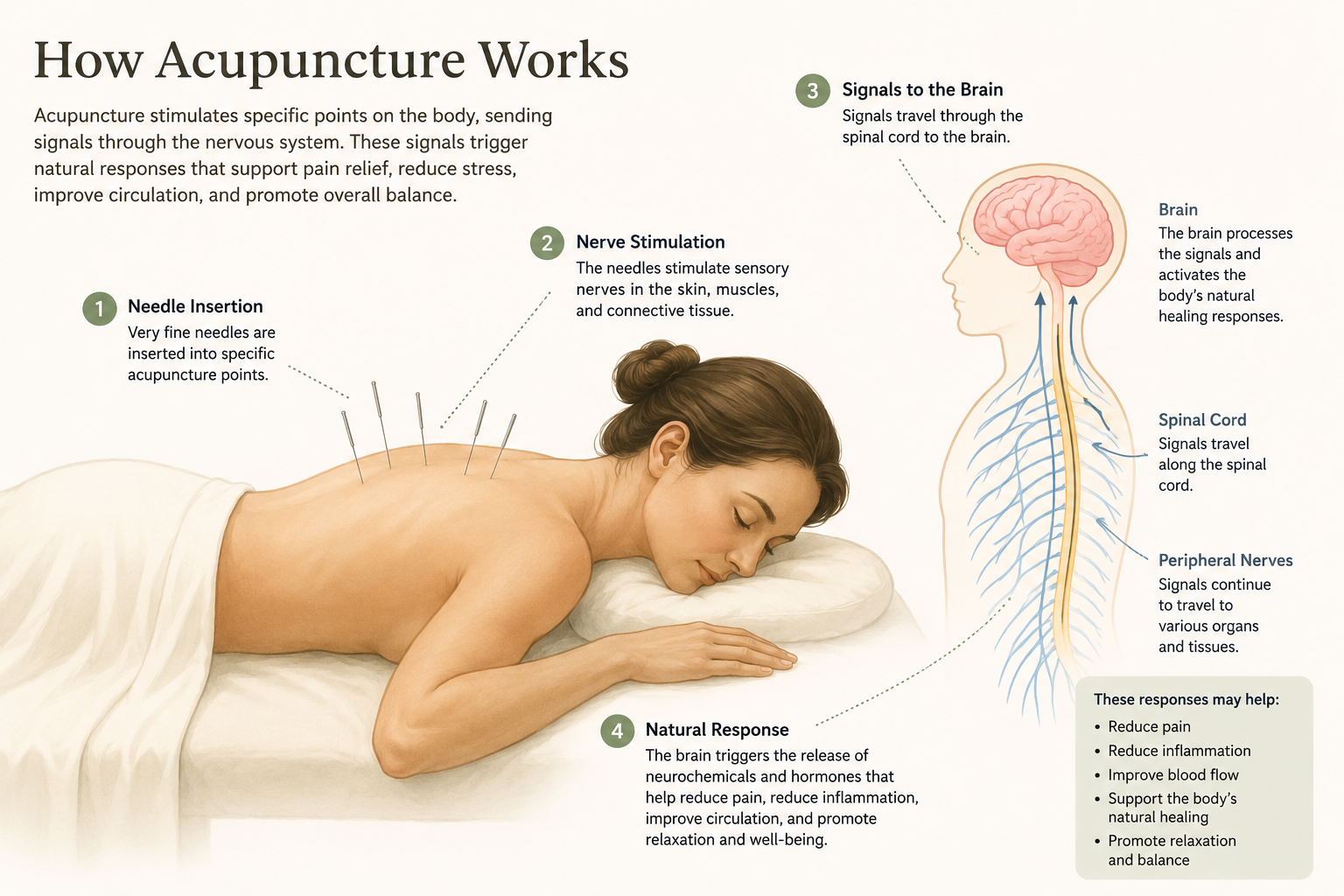
When an acupuncture needle is inserted, it stimulates sensory nerves within the skin, muscles, and connective tissue. These signals travel through the nervous system to the spinal cord and brain, where they trigger a variety of biological responses.
Research suggests acupuncture may:
Stimulate the release of the body's natural pain-relieving chemicals, including endorphins.
Influence neurotransmitters involved in mood, stress, and emotional regulation.
Reduce inflammatory signaling in certain conditions.
Improve local blood flow and circulation.
Support regulation of the autonomic nervous system, helping shift the body from a "fight-or-flight" state toward a more relaxed "rest-and-digest" state. If you'd like to learn more about the relationship between acupuncture, stress, and nervous system regulation, you can read How Acupuncture Helps Reduce Stress: A Holistic Approach to Nervous System Health.
Rather than simply masking symptoms, these responses support the body's own ability to heal and regulate itself.
Why Can Acupuncture Help So Many Different Conditions?
One of the most common questions people ask is how acupuncture can help concerns that seem completely unrelated—such as back pain, headaches, digestive issues, anxiety, insomnia, allergies, or menstrual concerns.
From the perspective of Traditional Chinese Medicine, many symptoms can stem from underlying patterns of imbalance within the body. By addressing those patterns rather than treating symptoms in isolation, it's common to see improvements in several areas of health at the same time.
Modern science offers a complementary explanation. Because acupuncture interacts with multiple body systems—including the nervous, endocrine, circulatory, and immune systems—it can have wide-ranging effects throughout the body. Improving one regulatory system often influences others, which helps explain why patients frequently notice benefits beyond the condition that initially brought them in.
If you're curious about the conditions acupuncture may help support, I go into much more detail in my resource, What Can Acupuncture Treat?
What Does the Research Say?
Acupuncture has been extensively studied over the past several decades.
One of the largest analyses to date evaluated data from nearly 21,000 patients with chronic pain and found that acupuncture was significantly more effective than both no acupuncture and sham acupuncture for conditions including back pain, neck pain, osteoarthritis, and chronic headaches. These findings suggest that acupuncture's benefits cannot be explained solely by placebo effects.
Research has also shown that acupuncture influences multiple areas of the brain involved in pain processing and may stimulate the release of naturally occurring neurochemicals that help regulate pain perception and support healing.
The National Center for Complementary and Integrative Health (NCCIH) also recognizes growing evidence supporting acupuncture for several chronic pain conditions while continuing to investigate its role in many other areas of health.
As research continues to evolve, we're learning more about how acupuncture works from a biomedical perspective. At the same time, the clinical principles of Traditional Chinese Medicine continue to guide individualized treatment based on thousands of years of observation and experience.
Is Acupuncture Right for You?
Whether you're seeking relief from chronic pain, headaches, stress, anxiety, digestive concerns, women's health conditions, or simply looking for a more holistic approach to wellness, acupuncture offers a safe, personalized treatment designed to support your body's natural healing abilities.
If you've been wondering whether acupuncture could help you, I'd love to answer your questions and discuss whether it's a good fit for your health goals.
Healing doesn't always mean forcing the body to work harder. Sometimes it begins by giving the body the opportunity to slow down, regulate, and do what it was designed to do.
Graceful Healing Acupuncture & Wellness proudly serves Golden, Denver, Lakewood, Arvada, Wheat Ridge, Evergreen, and Morrison communities.
References
Vickers AJ, et al. (2018). Acupuncture for Chronic Pain: Update of an Individual Patient Data Meta-Analysis.
Zhao ZQ. (2008). Neural Mechanism Underlying Acupuncture Analgesia.
Han SP, Han JS. (2020). Acupuncture and Related Techniques for Pain Relief and Treatment of Heroin Addiction: Mechanisms and Clinical Application.
National Center for Complementary and Integrative Health. Acupuncture: Effectiveness and Safety.